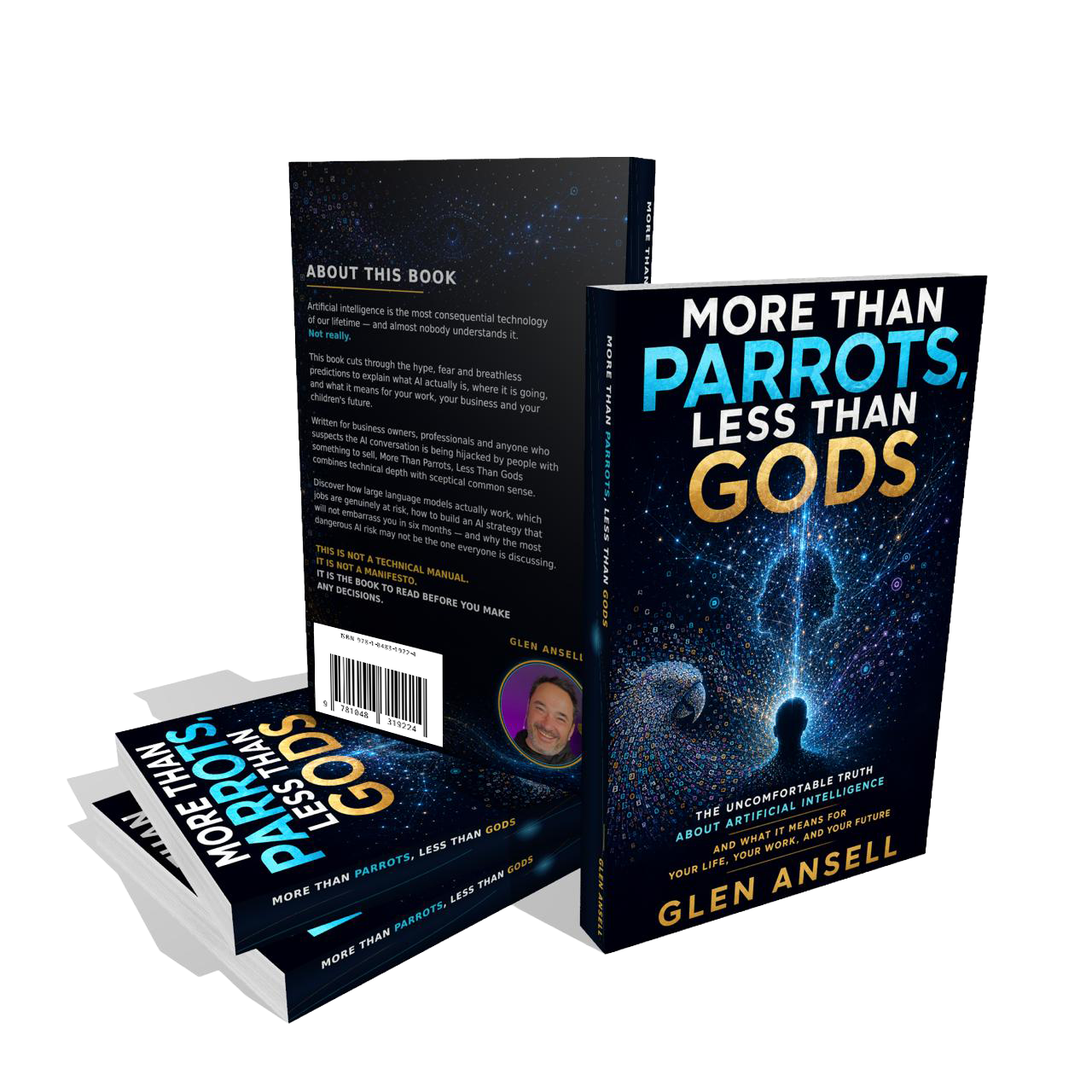
A field guide to the human-AI partnership. How to stay relevant, valuable, and deeply human in a world that wants to automate everything.
Three ways to engage with the book before you buy.
Nineteen chapters organized into six clear parts.
Chapters 1-4. What AI actually is, how it developed, why the transformer changed everything, how large language models work, and why these systems can produce brilliant answers and confident nonsense from the same underlying machinery.
Chapters 5-8. The major players, how ChatGPT, Claude, Gemini, DeepSeek and other systems fit together, why AI agents matter, how the global AI race is unfolding, and why regulation, chips, data, and geopolitical power are becoming inseparable.
Chapters 9-11. Which roles are most exposed, which industries are already being reshaped, why junior work is under pressure, and which human skills become more valuable as AI takes over routine cognitive tasks.
Chapter 12. How AI is already being used in scams, deepfakes, misinformation, cyberattacks, biased decision-making, and systems where human responsibility is quietly hidden behind "the AI said so."
Chapters 13-16. How businesses should build an AI strategy, why so many AI projects fail, how individuals can use AI tools without becoming dependent on them, how to preserve critical thinking, and what children need to learn to thrive in an AI-shaped world.
Chapters 17-19. What AGI might mean, why timelines are so contested, which risks actually matter, and how society can think more clearly about the future we are building.
Start applying the book's concepts before you even buy it.
20 questions. Instant score. Personalized report on where you stand.
Start AssessmentWhat should you budget for AI tools? Personalized estimate based on your role.
CalculateAuthor, AI Strategist, Skeptic
I've watched AI go from academic curiosity to boardroom buzzword. I've built systems that worked and systems that failed. This book is what I wish someone had handed me five years ago — a skeptical, practical, deeply researched guide to working with AI without losing your mind or your job.
Glen Ansell is Chief Commercial and Operations Officer at Tangent Solutions, with an MSc in Research Psychology and a Harvard certificate in AI. He has spent 12+ years building AI and modeling systems across software, cloud, automation, and industrial IoT.
Read Full BioGet a taste of the skeptical, first-person voice that makes this book different from every other AI book on the shelf.
Read Free PreviewYou've read the AI books that promise utopia. You've seen the ones that predict doom. This is neither.
This is a practical, skeptical, deeply researched guide to working alongside AI — written by someone who's been building AI systems for 12+ years and still thinks most AI marketing is bullshit.
Available in every format that matters.
Each chapter as a podcast dialogue and video walkthrough.
Chapter dialogues in conversation format
Listen to each chapter as a dialogue between Glen and a skeptic. Perfect for commutes, walks, or when you want the ideas without the reading.
Listen on SpotifyVideo walkthroughs of every chapter
Watch Glen break down each chapter with visuals, examples, and live Q&A. Subscribe for new chapter videos every week.
Watch on YouTubeJoin 2,000+ readers getting weekly insights on AI strategy. No hype, no spam — just useful stuff.
Free chapter + scorecard access. Unsubscribe anytime.
The phrase "More Than Parrots, Less Than Gods" captures the essential truth about artificial intelligence in 2026. AI systems are neither mindless mimics nor omniscient oracles. They are powerful tools that augment human capability when used with skill, and create costly errors when used without understanding.
This field guide to the human-AI partnership spans 19 chapters across six major themes:
Whether you are a business owner evaluating AI investments, a parent discussing technology with your children, a professional future-proofing your career, or a policymaker designing AI governance, this book provides frameworks that cut through hype and deliver actionable insight.
AI capabilities have advanced dramatically, but the fundamental challenges remain: hallucination, bias, context limitations, and the gap between demo and production. Understanding these limitations is not pessimism — it is the foundation of effective AI strategy. The organizations that succeed are those that match AI capabilities to human judgment, not those that expect AI to replace human thinking entirely.
Explore more: Anthropic Research · OpenAI Research · McKinsey State of AI